SIMPEL vs. Procore: Choosing Construction Management Software
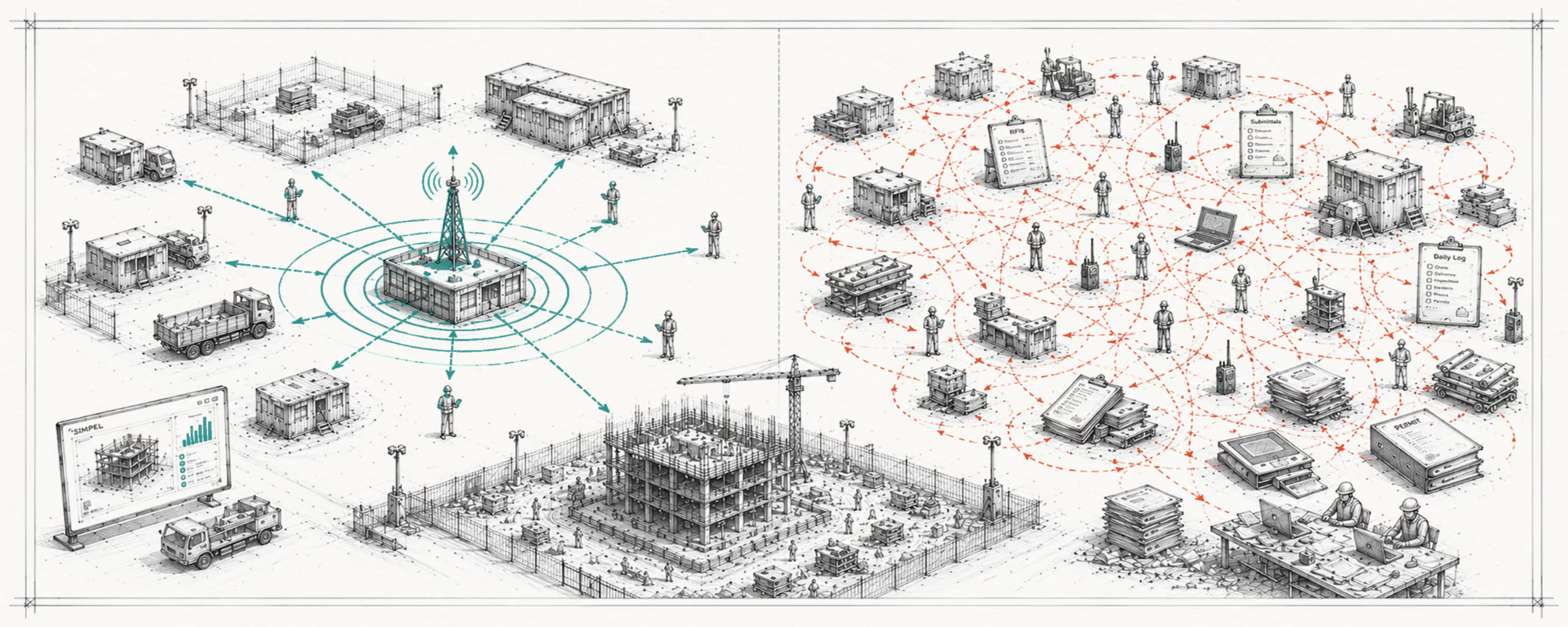
Choosing construction software isn’t just a procurement decision. It’s a commitment that shapes how your projects run, how your data moves, and how your organisation scales. SIMPEL and Procore are two platforms that serve this space, but they’re built on fundamentally different philosophies and that difference has a real impact on how your organisation operates day to day.
Deciding between the two often comes down to architecture: how much administrative overhead do you have resources for, how many vendors are you willing to manage, and what does your technology stack look like in three, five, or ten years?
This comparison breaks down the key differences between SIMPEL and Procore across operations, data management, change management, pricing, and security.
SIMPEL & Procore: A Quick Overview
What is SIMPEL?
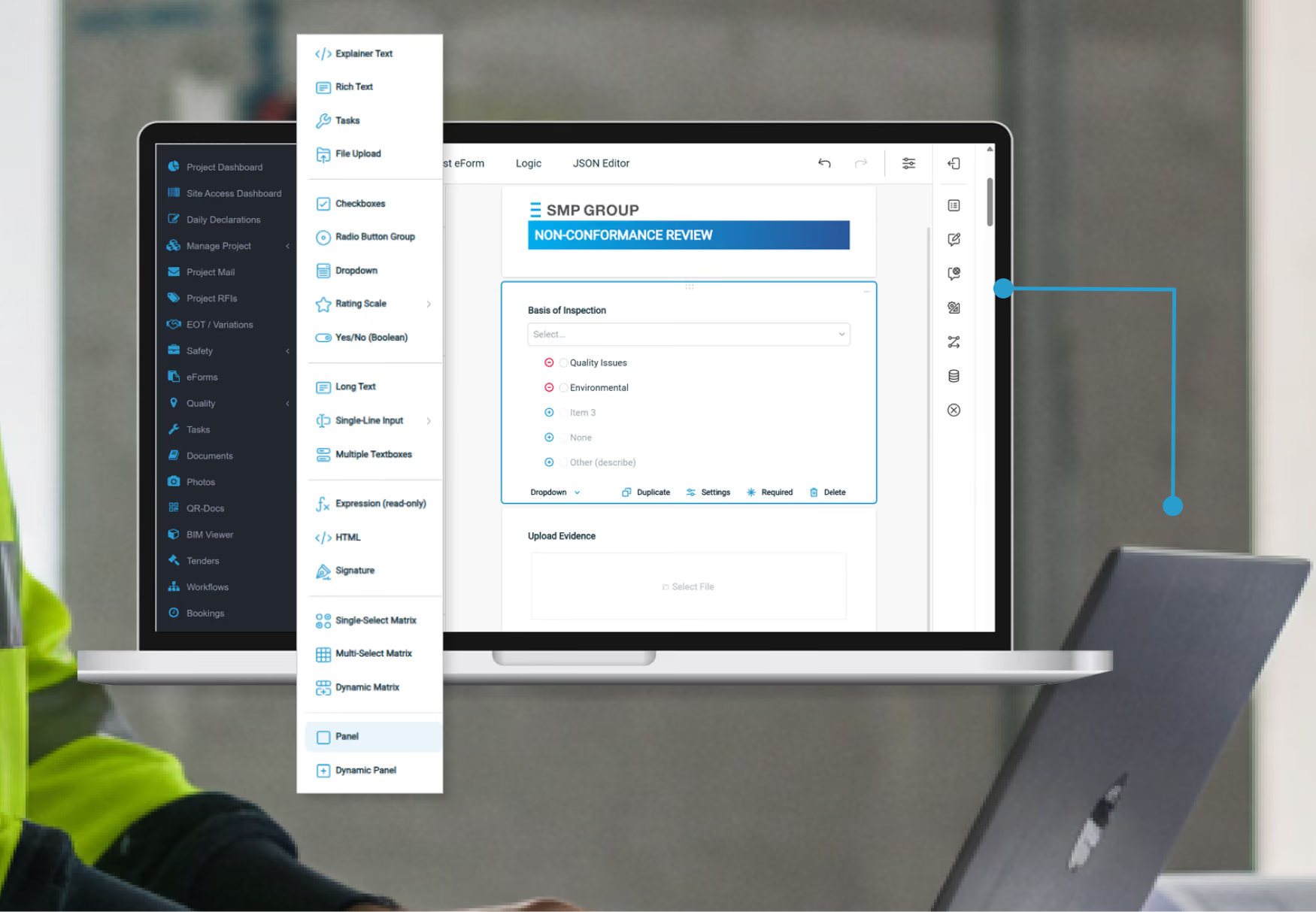
SIMPEL is a construction management platform built to manage operations from preconstruction through to handover. Its entire feature set, spanning document and design management, safety, quality management, site access, and reporting is natively built and delivered in a unified Common Data Environment (CDE), and is supported by proprietary hardware developed as one with the software.
What is Procore?
Procore is a widely recognised construction management platform with a broad feature set and strong global presence. Procore operates as a project management and financials platform that's extended through its App Marketplace, where third-party vendors supply additional functionality for things like safety, site access, and logistics management.
In practice, this means Procore's full operational capability often depends on the integration of a collection of separately licenced, separately operated apps rather than a single, natively connected system.
Data Management: Unified vs. App Marketplace
How data is captured, securely stored, and made accessible is worth examining closely, particularly for organisations moving toward more strategic, data-driven decision-making.
The value of a Common Data Environment (CDE)
SIMPEL was built with the principles of a CDE at its core, not as a bolt-on or integration. When a project team is actively using the platform, from subcontractors actioning onsite tasks to quality managers signing off on defect resolutions, every submission generates data that flows upward in real time.
Because that data is captured in one environment, it’s structured, reliable, and ready for immediate use. Native Project Dashboards make live project data actionable, surfacing what’s happening as work progresses and creating a direct path from project insight to operational action. Organisation Intelligence brings portfolio performance into one view, so reporting, performance tracking, and compliance monitoring are built into the way the platform operates.
The accuracy and cleanliness of that data also puts organisations in a strong position to adopt emerging technologies, AI included, as the industry continues to evolve.
The app marketplace approach
When data is spread across Procore and multiple third-party apps, aggregating, comparing, and analysing it becomes a more manual process. Project managers may need to pull information from multiple sources to get a complete picture, and with data moving across systems via API connections, there's an inherent risk of errors or inconsistencies entering the record.
This isn’t a hypothetical concern; it’s a known trade-off of the app marketplace model. Even when integrations are well-configured, they introduce additional complexity, potential synchronisation failures, and administrative overhead that simply don’t exist in unified systems.
"There was a lot of back-end administration to make sure that everything went from one area to another. We were loading contractors into Procore and expecting it to automatically populate into 1Breadcrumb. It was supposed to, but it didn’t really work like that. It was a lot of back-end fiddling around to make things work.” - Lloyd Lucas, Quality & Systems Manager, Complex Co.
Pricing & licensing: Understanding the total cost of ownership
Most organisations don't set out to manage five platforms. It usually starts with one as an entry point for digitising, then another for additional functionality, and another to bridge the gap between the first two, until the tech stack has blown out in ways that weren't planned for. That's not a criticism of any single tool. It's just how point solution models tend to evolve over time. As they do, the total cost of ownership becomes harder to see and harder to control.
How SIMPEL Approaches Pricing
SIMPEL operates on an unlimited user licensing model, which suits construction projects where the workforce fluctuates significantly across the project lifecycle. There's no per-user charge that escalates mid-project when subcontractor numbers peak.
Organisations select only the modules relevant to their needs and scale up as requirements evolve, without needing to manage a new vendor relationship. One vendor, one contract, and a cost structure that stays transparent and predictable.
Procore and the App Marketplace Model
Procore's core platform pricing is based on the functionality selected and the volume of construction managed. Where additional operational capability is needed, that typically means adding additional third-party apps, each with their own licensing and fee arrangements.
Multiple licences across departments accumulate into a bill that's harder to forecast and control, and API setup, maintenance, and third-party middleware add both direct and indirect expenditure on top of that. When systems don't communicate naturally, staff fill the gaps manually, a cost that never shows up on an invoice but impacts productivity all the same.
Onboarding, adoption, and ongoing support: Ensuring use on site and in the office
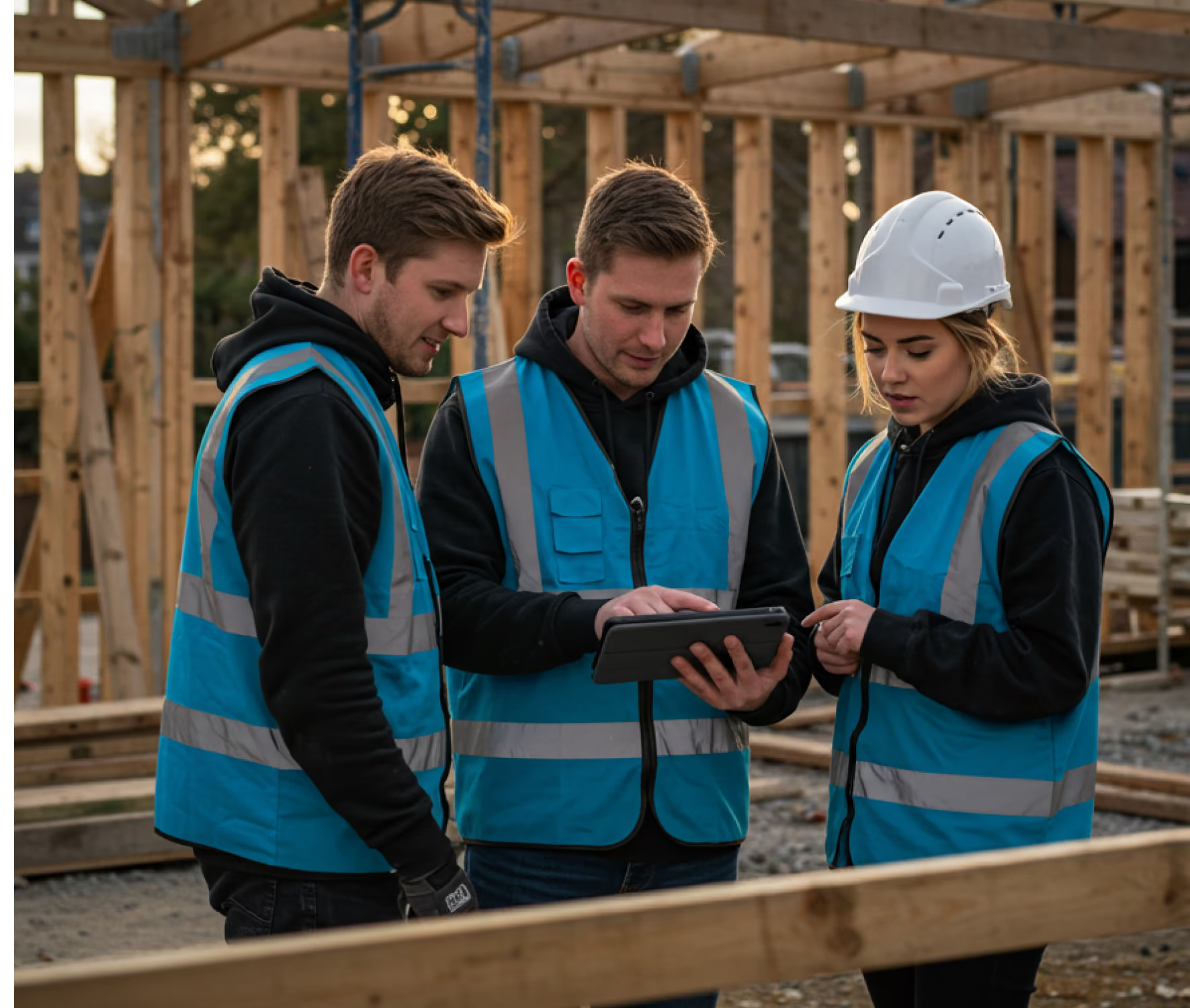
The true measure of any construction software isn't what it can do in theory; it's whether the people on your sites will actually use it. Adoption by subcontractors, site staff, and leadership alike is where many platforms fall over, and the onboarding experience is a big part of why.
SIMPEL’s approach to change management
SIMPEL’s single-platform model means onboarding happens once. There's one system for both principal contractors, consultants, subcontractors, and the supply chain to learn, and one SIMPEL Passport profile that travels with each company and user across all projects and organisations. When someone's already used SIMPEL on a previous project, they don't start from scratch on the next one.
SIMPEL’s onboarding support includes:
- Regional Support Lines: Dedicated, region-based support lines staffed during construction hours, with local phone numbers answered by teams who understand local requirements.
- In-house Client Success Team: Organisations are supported by SIMPEL’s in-house Client Success Team who are focused on providing regular check-ins, ongoing guidance, and long-term familiarity with operational priorities and stakeholders.
- Standard Project Setup & Training: Comprehensive project setup and user training included as standard, ensuring teams are configured correctly from day one and confident in using the platform.
- Custom Onboarding & Implementation Plans: Tailored onboarding and implementation plans designed around your workflows, project structure, and team needs to ensure smooth adoption and minimal disruption.
- Onsite Training Options: Onsite training available by arrangement, allowing teams to receive hands-on, practical guidance in their working environment for faster uptake and stronger engagement.
The multi-app onboarding process
With a marketplace model, onboarding isn't a single event; it's a repeated one. Each app added to the stack requires its own setup, its own training, and its own rollout to the workforce. That means navigating different systems, different logins, and different interfaces daily. The cumulative effort adds up, and the more apps in the stack, the steeper the adoption challenge becomes.
Support for each app is typically managed by each third-party vendor separately, which can mean dealing with overseas-based support teams, varying response times, and no single point of accountability when something isn't working. This can result in fragmented support, with ticket-based queries, limited project context, and no consistent local contact when issues impact work on site.
After 12 months of onboarding with our previous provider, we were still not at the point where we could implement it with our subcontractors. It's been completely different with SIMPEL. We were surprised by how quickly we could onboard. The team was trained and using it in a matter of weeks.” - Training Coordinator, Degnan
Security & data sovereignty
The stakes for security are getting higher. For everyone. But for organisations delivering government, defence, or high-security construction projects, security credentials and data sovereignty aren't peripheral considerations; they're strict procurement requirements.
Certifications & Compliance Standards
SIMPEL
Has undergone an Australian Government IRAP (Information Security Registered Assessors Program) assessment to PROTECTED level, making it the only global provider operating at this standard. IRAP is administered by the Australian Cyber Security Centre (ACSC), part of the Australian Signals Directorate, and evaluated against the Australian Government Information Security Manual (ISM). It means SIMPEL’s software and hardware can be deployed in environments where security requirements are at their highest.
Additionally, SIMPEL’s infrastructure is hosted on Microsoft Azure, supported by their broad compliance portfolio spanning international, industry-specific, and regional standards, including ISO 27001, HIPAA, FedRAMP, SOC 1, SOC 2, Australia’s IRAP, the UK’s G-Cloud, and Singapore’s MTCS.
Procore
Holds ISO 27001 certification and SSAE 18 SOC 1 & 2 Type 2 compliance, and Procore for Government is FedRAMP Moderate Authorised. ISO 27001 and SOC reporting relate to information security and service controls, while FedRAMP is designed for US federal agencies and contractors.
For Australian and UK businesses, these credentials should be considered alongside local procurement requirements, data residency expectations, and the security position of any third-party applications connected through the marketplace.
Data Sovereignty & Deployment Options
SIMPEL
Operates on a regional data model: Australian project data is stored and backed up on Australian servers while UK project data stays within UK infrastructure. For projects with the highest security requirements, SIMPEL also supports air-gapped deployments with no cloud or cellular connectivity, as well as a Secure Microsoft Cloud option and offline field functionality for environments where connectivity is restricted.
Procore
Procore offers regional data zones across 15 countries, allowing customers to select a preferred location for file storage. However, Procore's own documentation notes that data may still be stored or processed outside the selected region for purposes including logging, support, maintenance, and authentication. Application data and file data are also stored separately, across different infrastructure. With a marketplace model, data storage for third-party apps varies depending on where each provider's servers are located.
Site Access Controls & Hardware
SIMPEL
Hardware
SIMPEL’s site access hardware, including biometric systems, turnstiles, speed gates, and boom gates, were developed as one cohesive system with the software. Within milliseconds of an entry attempt, SIMPEL confirms a worker's identity, checks induction status, and verifies completion of a daily declaration, with gate hardware automatically denying entry and alerting management if any check fails.
Zone Management
For high-security environments, Zone Management extends this further, controlling where workers go once inside a project. Restricted areas, security clearances and role-based access permissions, and access timeframes are all configured within the platform, with every movement logged in real time and a complete audit history of every zone change maintained.
Live Dashboards
The Site Access Dashboard maintains a real-time register of all site movements across projects and organisations, providing a fully auditable history of every worker's compliance status. Access data can also be used to analyse safety and resourcing trends over time.
Procore
Rather than a natively built solution, Procore's site access capability relies completely on third-party software and hardware integrations.Where software is retrofitted to work with external hardware, real-time data synchronisation isn't guaranteed, and resolving issues typically involves more than one support team.
Unified, structured data is nonnegotiable for AI
AI is quickly moving from a buzzword to a genuine operational tool in construction, but it’s only as effective as the data it operates on. The organisations best positioned to benefit from it are those with unified, structured data. It’s not a nice-to-have, it’s a fundamental requirement for meaningfully deploying AI and emerging technologies.
A multi-application approach can still support day-to-day operations, but it often requires ongoing effort to align data across systems. Even with integrations, maintaining consistency isn’t guaranteed, which can limit how effectively more advanced technologies are adopted over time.
SIMPEL vs. Procore: Which platform is the better fit?
The question isn't which platform to pick. It's which model gets you further, faster.
For some organisations, a marketplace model is enough. For those that have outgrown it, the move has been away from a collection of point solutions and toward a consolidated approach where project data flows directly from site level into organisational insight.
SIMPEL might be a better fit if your organisation:
- Data security: Where data is confined and controlled to the highest standards
- Scaling workforces: Needs pricing that doesn't climb with your subcontractor headcount
- Site adoption: Wants software that's intuitive enough for boots on the ground to actually use
- High-security or government projects: Requires IRAP assessment, data sovereignty, and air-gapped deployment options
- Tech stack consolidation: Wants to reduce its vendor footprint
- Data maturity: Needs clean, connected reporting without manual consolidation and is ready to leverage AI
- Local operations: Operates in Australia or the UK and wants locally hosted data with support available during construction hours
What would your operations look like in a unified platform?
Choosing between SIMPEL and Procore is ultimately about choosing a technology model, not just a software product. Procore offers an established brand with a broad marketplace.SIMPEL offers one ecosystem, one data set, one experience, and is built for how work happens.
Before renewing a licence or committing to a new contract, it's worth asking: how many systems are running in parallel today, how much admin time is going toward managing them, and whether the data being captured is actually accessible in a way that drives decisions for the future of AI?
If the answer points toward consolidation, SIMPEL is worth a serious look.
Book a demo to see how SIMPEL’s end-to-end platform compares.
Frequently Asked Questions
What’s the difference between SIMPEL and Procore in construction project management?
The main difference between SIMPEL and Procore is how they bring structure to construction project management. Procore extends its platform through an ecosystem of third-party applications, while SIMPEL delivers document and design, management, safety, quality, site access, logistic, and reporting within a single Common Data Environment. The result is a simpler user experience, a consistent and connected data set, reduced administrative overhead, and greater confidence in project reporting and organisational insight.
Which construction management software is better: SIMPEL or Procore?
Choosing between SIMPEL and Procore depends on your organisation’s needs. Procore is often selected by organisations that rely on a broad ecosystem of third-party tools, while SIMPEL delivers the depth and coverage construction teams need in a single platform, reducing complexity and accelerating adoption.
How do SIMPEL and Procore compare on total cost of ownership?
When comparing construction software like SIMPEL and Procore, total cost of ownership includes more than licensing. Procore implementations can involve additional costs for integrations, configuration, and support, while SIMPEL’s unified approach typically reduces the need for third-party tools, helping to keep long-term costs more predictable.
What should I look for when comparing construction project management software?
When comparing construction project management software like SIMPEL and Procore, it’s important to evaluate data structure, ease of use, integration requirements, and scalability. A key consideration is whether the platform offers a unified system or relies on multiple tools to deliver full functionality.
Is a unified construction management platform better than an integrated one?
In construction management, a unified platform like SIMPEL brings all project data and workflows into one system, improving consistency and reducing complexity. In contrast, integrated platforms like Procore often rely on multiple connected tools, which can offer flexibility but may introduce additional overhead in managing data and workflows.

Sign up to Simpel's Newsletter
A quick read with our latest news, blogs, recent software releases, and big company updates